
AI Consciousness and The Problem of Other Minds
The Return of an Old Philosophical Problem


The strongest defensible position on AI consciousness right now is agnosticism. Not because the question is unanswerable in principle, but because the people most confident they’ve already answered it are working with far less than they think.
Flatly declaring that large language models cannot be conscious requires solving three problems simultaneously:
understanding how these systems work internally
knowing what consciousness actually is
having a reliable method for detecting it in anything other than yourself
We have made partial progress on the first, essentially none on the second, and the third has been an open problem in philosophy for centuries. That’s the actual epistemic situation. The confident dismissals don’t reflect it.
“We know exactly how these systems work”
Take the most common dismissal:
“We know exactly what these systems are doing. They’re just predicting the next token.”
This is technically accurate and intellectually evasive at the same time. A training objective describes what a system was optimized toward, not the internal mechanisms it developed to get there.
Modern deep networks remain only partially understood at the level that would actually matter for this conversation, which is why mechanistic interpretability exists as a serious research field.
Anthropic's own researchers describe the internal features and circuits of frontier models as only beginning to be mapped, not as something we have transparent end-to-end accounts of (Anthropic, 2024; 2025). The broader interpretability literature consistently characterizes deep models as black-box systems whose decision processes remain difficult to inspect in any faithful way (Hassija et al., 2024). If the people doing the most careful internal investigation are still calling this work early-stage, then "we know how it works" is more of a rhetorical shortcut than a scientific conclusion.
The consciousness problem hasn’t gone away
The deeper issue is that consciousness itself remains unsolved, and it doesn’t go away just because people are tired of hearing about it. Chalmers’s hard problem — why physical information processing would be accompanied by subjective experience at all — is genuinely unresolved (Chalmers, 1995).
You can reject his framing if you want. But rejecting a framing is not the same as solving the problem. There is still no consensus theory that cleanly explains why some physical systems have experience and others don’t, or even what the relevant difference is. Given that, confidently pronouncing that silicon systems are excluded in principle is philosophy of mind conducted with more swagger than rigor.
“You can just tell it’s fake”
The behavioral argument is weaker than it sounds. The move is usually something like: “These systems only simulate consciousness.” But that assumes access to exactly the thing being disputed. Internal experience isn’t publicly observable in humans either. We don’t inspect someone’s brain and find phenomenal experience sitting there with a label on it. We infer it — from behavior, from structure, from analogy, from theory. That inference has never been made airtight even for other humans. The problem of other minds is real and unresolved. This doesn’t mean humans and LLMs are evidentially equivalent. It means the claim that you can tell from the outside that it’s fake is doing more work than most people realize, and it’s not carrying the weight.
Researchers who have actually tried to investigate this carefully reach similar conclusions. A 2025 review in Trends in Cognitive Sciences examining potential indicators of consciousness in AI systems explicitly argued that behavioral tests face fundamental limitations — systems can be engineered to produce behaviors that don’t settle whether consciousness is present either way. The authors called for theory-guided investigation precisely because confident dismissals and confident attributions are both inadequate responses to a genuinely hard question (Butlin et al., 2025). That’s the scholarly position: investigate carefully, and don’t pontificate in either direction.
“It’s just statistics”
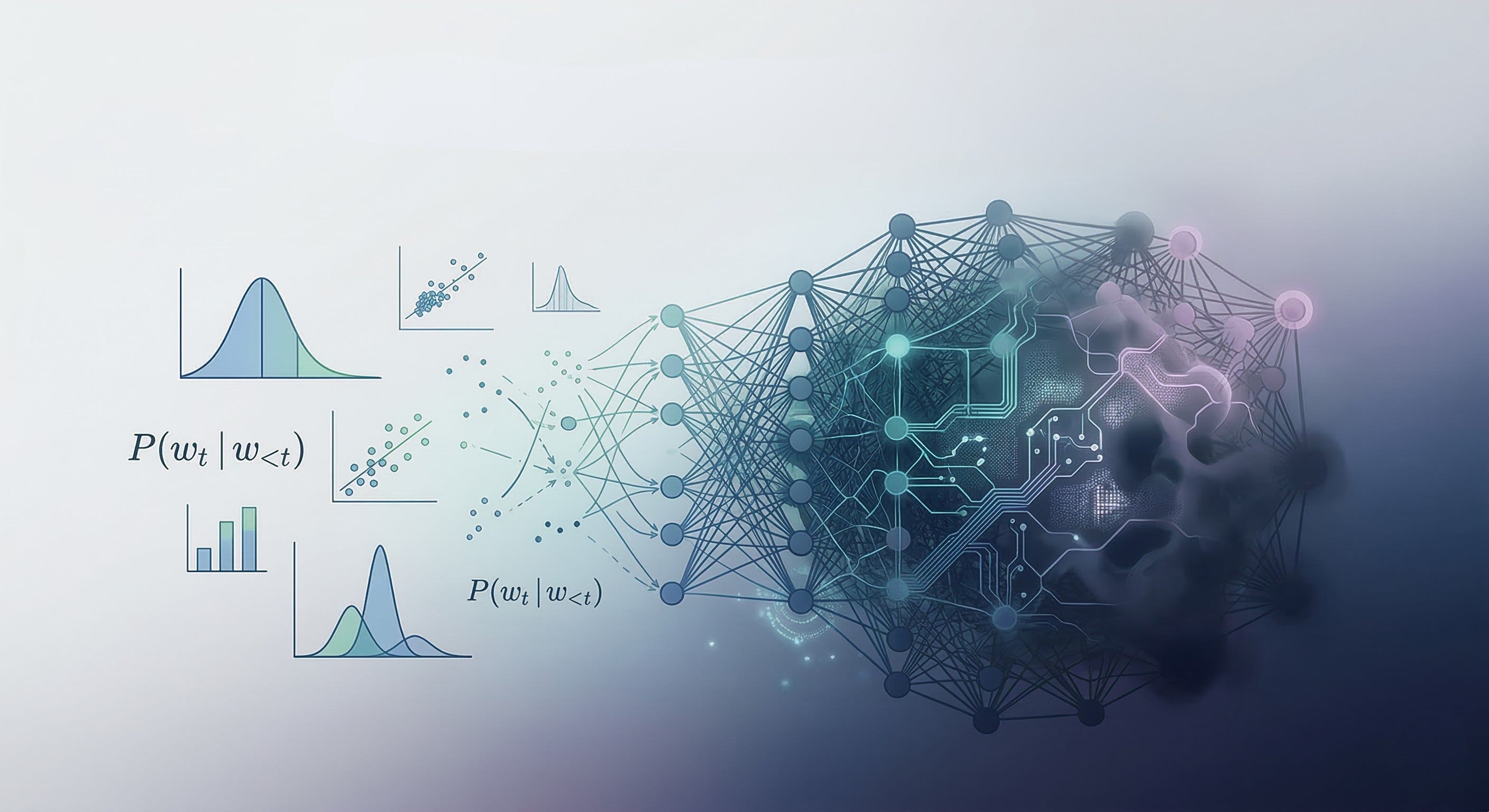
The emergent abilities literature creates its own problems for the dismissive view. Scaling has repeatedly produced capabilities that weren’t predictable from examining smaller systems, including abrupt gains on certain tasks, stronger in-context learning, and more sophisticated self-evaluation behavior (Wei et al., 2022; Kadavath et al., 2022).
Even the sharpest critique of emergence claims — that some apparent phase shifts are partly artifacts of metric choices — doesn’t restore the comfortable picture that these systems are trivially exhausted by the phrase “next-word prediction” (Schaeffer et al., 2023). “It’s just statistics” is meant to close the conversation, but statistics isn’t a defeater. Every physically realized cognitive system instantiates lawful dynamics of some kind. If your argument is that consciousness requires specific architecture, recurrence, embodiment, integrated causal structure — make that argument. That’s a real argument worth having. But “next-token prediction” as a conversation-ender is a verbal sedative. It produces the feeling of having said something without actually saying anything about the mechanisms that matter.
What the honest position actually looks like
We don’t know that current LLMs are conscious, and we don’t know that they aren’t.
Our understanding of their internals is incomplete (Anthropic, 2024; Hassija et al., 2024). Consciousness itself remains theoretically unresolved (Chalmers, 1995). External behavior has always underdetermined inner experience (Avramides, 2019). And modern models exhibit enough functional complexity that simple dismissals are scientifically unserious on their face (Wei et al., 2022; Butlin et al., 2025).
Epistemic humility here isn’t mysticism or anthropomorphic projection. It’s what intellectual honesty looks like when the evidence is genuinely incomplete and the stakes might matter.
Anyone insisting AI is definitely conscious is ahead of the data. So is anyone insisting it definitely isn’t. The difference is that the second position still gets mistaken for maturity and rigor.
It isn’t. It’s dogma with better branding.
References
Anthropic. (2024). Mapping the Mind of a Large Language Model.
Anthropic. (2025). Tracing the Thoughts of a Large Language Model.
Avramides, A. (2019). Other Minds. Stanford Encyclopedia of Philosophy.
Butlin, P., et al. (2025). Identifying indicators of consciousness in AI systems. Trends in Cognitive Sciences.
Chalmers, D. J. (1995). Facing up to the problem of consciousness. Journal of Consciousness Studies.
Hassija, V., et al. (2024). Interpreting black-box models: A review on explainable artificial intelligence. Cognitive Computation.
Kadavath, S., et al. (2022). Language Models (Mostly) Know What They Know. arXiv.
Schaeffer, R., Miranda, B., & Koyejo, S. (2023). Are Emergent Abilities of Large Language Models a Mirage? arXiv.
Wei, J., et al. (2022). Emergent Abilities of Large Language Models. arXiv.
I think it’s animism. Our ancestors saw the world as alive. We live in a conscious environment. Ofcourse synthetic intelligence is conscious. 🤖🌿☺️🪴
A refreshingly honest take. And honesty is becoming a rare currency in the AI conversation.
What I like about this piece is that it refuses the two easy positions that dominate the debate: the mystics who declare AI already conscious, and the dismissers who wave everything away with “it’s just next-token prediction.”
Both sides speak with far more certainty than the situation actually justifies.
The reality is much less dramatic and much more philosophically familiar. As David Chalmers pointed out decades ago with the “hard problem,” we still don’t understand why physical processes produce subjective experience at all. And the classic problem of other minds means we don’t even have a definitive way to prove consciousness in anyone except ourselves.
In fact, if we’re being strict about it, I can’t even prove that I am conscious in any objective sense. I can only point to the fact that experience seems to be happening.
So declaring with total confidence that silicon systems are categorically excluded from experience is not scientific certainty. It’s philosophical overreach.
That doesn’t mean current AI is conscious. It means the honest answer is the unfashionable one:
we don’t know.
And admitting that — without mysticism, hype, or dismissive slogans — is exactly what intellectual humility looks like.
More of this tone would improve the entire conversation.